How to Maximise Solar Output During Wet Staffordshire Weather?
You can’t control Staffordshire’s weather — but you can control how well your system responds to it. The key strategies are: shifting energy use to daytime generation hours, adding battery storage to capture every kilowatt-hour produced, choosing the right panel technology, keeping panels clean, and monitoring your system closely for underperformance. Done well, these steps can significantly close the gap between a wet winter day and a clear summer afternoon.
Does Wet Weather Significantly Hurt Solar Output in Staffordshire?
More than most homeowners realise — but less than they fear.
Staffordshire receives around 1,050–1,150 kWh of solar irradiance per square metre per year. Wet, overcast conditions are common from October through to March. During heavy cloud cover and rain, a 4kWp system that generates 400–490 kWh in June might produce just 70–120 kWh in December.
That’s a significant seasonal swing. But it doesn’t mean your system is idle.
Even on a grey Staffordshire morning, diffuse light still reaches your panels. Output of 10–30% of rated capacity is typical on heavily overcast days. On a bright but cloudy day — common in Staffordshire spring and autumn — output can reach 50–70% of rated capacity.
The goal is to make absolutely sure that every kilowatt-hour generated in those conditions is put to good use. Wasted generation on a low-output day is far more costly than wasted generation on a sunny one.
1. Add Battery Storage — The Single Biggest Upgrade
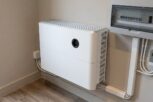
If you want to maximise returns during wet Staffordshire weather, battery storage is the most impactful change you can make.
Here’s why it matters so much on low-output days.
On a clear summer day, a 4kWp system might generate 30–40 kWh. Even without a battery, there’s a good chance some of that generation aligns naturally with daytime energy use — cooking, appliances, charging devices.
On a wet October day, the same system might generate just 6–10 kWh across the entire day. Generation is spread thinly across daylight hours. Without a battery, much of that trickle of electricity exports to the grid at a low Smart Export Guarantee rate — often 4–6p per kWh — whilst you buy electricity back at 24.5p per kWh in the evening.
A battery changes that equation entirely. It captures the trickle throughout the day and releases it when you need it most — typically early morning and evening peaks when grid electricity is most expensive.
Real-world impact in Staffordshire:
A 5kWh battery paired with a 4kWp system in Staffordshire can increase self-consumption from roughly 30–40% to 60–75% annually. During winter months specifically, a well-sized battery can mean the difference between exporting nearly all your generation at low rates and self-consuming the majority of it at full value.
What size battery do you need?
| Household Size | Daily Electricity Use | Recommended Battery Size |
| 1–2 person home | 5–8 kWh | 5 kWh |
| 3–4 person home | 8–12 kWh | 10 kWh |
| 4–5 person home | 12–16 kWh | 10–15 kWh |
| Large home with EV | 16–25 kWh | 15–20 kWh |
Popular battery options for Staffordshire homeowners include the Tesla Powerwall 3, GivEnergy All-in-One, and SolarEdge Home Battery. At Makse Electrical & Renewables, we supply and install a range of battery systems suited to different budgets and property sizes.
External link: Energy Saving Trust — Home Battery Storage Guide
2. Shift Energy Use to Peak Generation Hours
This costs nothing and can make an immediate difference — regardless of whether you have a battery.
On wet days, generation is lower but not absent. Your panels still produce their best output during the middle of the day — typically between 10am and 2pm even on overcast days. This is when diffuse light intensity is at its highest.
Running high-consumption appliances during this window maximises direct self-consumption and reduces your reliance on grid electricity.
Appliances to time for daytime hours:
- Washing machine — one of the highest single-cycle consumers at 1–2 kWh
- Tumble dryer — 2.5–4 kWh per cycle
- Dishwasher — 1–1.5 kWh per cycle
- Electric oven — 1–2 kWh per hour
- EV charging — 7–22 kWh per session depending on charger speed
Most modern appliances have delay timers built in. Set your washing machine to finish at noon, not midnight. Run your dishwasher at lunchtime, not after dinner.
If you have a smart home system or energy management platform, you can automate this entirely. Systems such as Zappi EV chargers, myenergi Eddi hot water diverters, and GivEnergy AIO platforms can automatically direct surplus generation to specific appliances or storage — even on low-output days.
On a wet Staffordshire day in November, every kWh you self-consume is worth approximately 24.5p. Every kWh you export earns approximately 4–6p. The difference is significant.
3. Use a Solar Diverter for Hot Water
A solar diverter is a simple, cost-effective device that automatically redirects surplus solar electricity — electricity that would otherwise export to the grid — into your immersion heater.
On low-output wet days, your panels generate small but consistent amounts of electricity throughout daylight hours. Without a diverter, that surplus trickles to the grid at low export rates. With a diverter, it heats your hot water cylinder instead.
Hot water is one of the largest energy costs in a UK home — typically accounting for 15–20% of annual energy bills. Displacing that cost with surplus solar electricity, even on grey Staffordshire days, adds up meaningfully over the course of a year.
Popular solar diverters include the myenergi Eddi and the Marlec Sunstore. They’re relatively affordable — typically £300–£500 installed — and deliver a fast payback in most Staffordshire homes with a hot water cylinder.
Note: Diverters are not suitable for combi boilers, which heat water on demand. They work with vented and unvented hot water cylinders.
4. Choose the Right Panel Technology for Low-Light Conditions
Not all solar panels perform equally in overcast, diffuse light conditions. Panel technology matters — particularly in Staffordshire where overcast days are common.
- Monocrystalline panels are the standard for UK installations and perform significantly better in low-light conditions than older polycrystalline technology. If your system was installed more than 8–10 years ago using polycrystalline panels, upgrading to modern monocrystalline panels could noticeably improve winter and wet-weather output.
- Half-cut cell technology is now standard on most modern panels. Splitting each cell in half reduces resistive losses and improves performance under partial shading and diffuse light. If you’re installing a new system or upgrading panels, half-cut monocrystalline is the right choice for Staffordshire conditions.
- Bifacial panels absorb light from both front and back surfaces. On overcast days, reflected diffuse light from the roof surface contributes to generation. The gain is modest in UK conditions — typically 5–10% — but worth considering on flat or low-pitch roofs with a light-coloured surface.
- High-efficiency panels — such as those from manufacturers like SunPower or REC — carry efficiency ratings above 22%. In practical terms, this means more electricity generated from the same roof area in the same light conditions. On a cloudy Staffordshire day, that efficiency advantage is proportionally more valuable than on a sunny day when even average panels perform well.
| Panel Type | Low-Light Performance | Ideal For |
| Standard monocrystalline | Good | Most UK installations |
| Half-cut monocrystalline | Very good | Staffordshire — recommended standard |
| Bifacial monocrystalline | Good + reflected gain | Flat roofs, light-coloured surfaces |
| High-efficiency mono (22%+) | Excellent | Limited roof space, maximising output |
| Polycrystalline (older) | Moderate | Being phased out — consider upgrading |
5. Add Microinverters or Power Optimisers
Standard string inverter systems are vulnerable to a phenomenon called the weakest link effect. If one panel in a string is shaded — by a chimney, a passing cloud shadow, or soiling — the output of every panel in that string is reduced to match the weakest performer.
On a wet, overcast Staffordshire day, partial shading from clouds and diffuse light conditions can create exactly this problem — panels on different parts of the roof may receive slightly different light intensities, dragging down the whole string.
- Microinverters fit to each individual panel and convert DC to AC at panel level. Each panel operates independently. One underperforming panel has no effect on the rest of the system.
- Power optimisers (such as those made by SolarEdge or Tigo) work similarly — each panel has its own optimiser that maximises its individual output before feeding into a central inverter.
Both solutions increase system resilience on low-light and variable-condition days. They also provide panel-level monitoring — you can see exactly which panel is underperforming and why, making fault diagnosis far easier.
For Staffordshire homes with complex roof shapes, multiple roof aspects, or nearby obstructions, microinverters or optimisers can meaningfully improve wet-weather performance.
6. Keep Panels Clean — Especially After Dry Spells
This seems obvious — but it’s frequently overlooked.
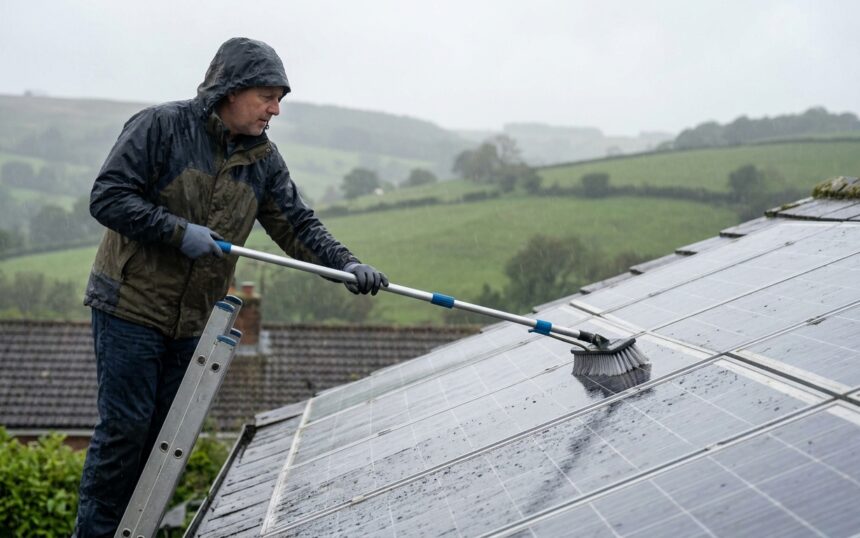
After a dry spell in Staffordshire, agricultural dust, pollen, traffic pollution, and bird fouling build up on panel surfaces. When the wet weather arrives, that accumulated grime doesn’t always wash off cleanly — it can bake on over weeks and create a persistent film that reduces light transmission.
A panel with a 5% soiling reduction operating at 20% capacity on an overcast day is effectively operating at 15% capacity. That proportional loss matters far more on a low-output day than a high-output one.
Clean panels heading into the wet season perform noticeably better than neglected ones. The autumn clean — ideally in September or early October — is particularly valuable for this reason.
For Staffordshire homeowners near Cannock Chase, agricultural land, or busy roads, consider a pre-autumn professional clean to ensure panels are in the best possible condition heading into the low-output winter months.
Internal link: Solar Panel Maintenance: A Complete Guide for Staffordshire Homeowners →
7. Optimise Your Roof Setup
If you’re planning a new installation — or considering upgrades to an existing one — roof setup has a significant impact on wet-weather performance.
- Orientation South-facing is optimal for maximum annual output. But for wet-weather performance specifically, the picture is slightly more nuanced. A split east-west installation generates more evenly across the day — capturing morning and afternoon diffuse light — rather than concentrating all generation around midday. On an overcast day when generation is limited regardless of orientation, spreading it across more daylight hours increases the chance of it aligning with your usage patterns.
- Tilt angle The optimal tilt for Staffordshire is 30–35°. Steeper pitches shed rain and debris more effectively — keeping panels cleaner between washes. Flat roof installations may benefit from angled mounting frames set to 15–20° minimum to encourage water run-off and self-cleaning.
- Avoiding shading On bright summer days, minor shading from a chimney or aerial may be tolerable. On an overcast winter day when every photon counts, that same shading can disproportionately reduce output. Before installation — or when reviewing an existing system — map shading carefully across winter sun angles, not just summer ones.
8. Use Time-of-Use Energy Tariffs
Smart energy tariffs — such as Octopus Agile, Octopus Flux, or OVO Beyond — allow you to buy and sell electricity at variable prices based on grid demand.
During periods of low grid demand overnight, electricity can be purchased at rates as low as 1–5p per kWh. On wet Staffordshire days when solar generation is low, using a smart tariff to charge your battery cheaply overnight means you’re still running largely on cheap electricity — even without significant solar generation.
Paired with a battery and a smart energy management system, time-of-use tariffs can transform a low-generation wet-weather day from a costly grid-dependency event into a cheap, managed energy period.
How it works in practice:
- On a wet November day, your panels generate 4–6 kWh total
- Your battery charges on cheap overnight tariff electricity at 3–5p per kWh
- You use battery power through the day, supplemented by whatever solar generation occurs
- Any surplus solar charges the battery before the evening peak
- You avoid buying electricity at the standard 24.5p rate throughout the day
9. Consider an Air Source Heat Pump
An air source heat pump (ASHP) paired with solar panels is one of the most effective combinations for year-round energy efficiency in Staffordshire.
Heat pumps are most efficient in milder, wetter conditions — exactly the kind of weather that reduces solar output. They work by extracting heat from outside air and amplifying it for home heating and hot water. Their efficiency — measured as a Coefficient of Performance (COP) — actually improves in cool, moist air compared to very cold, dry conditions.
So whilst solar output is lower on a wet Staffordshire day, your heat pump is running at higher efficiency. The two systems complement each other across the annual cycle.
Any solar electricity your panels generate on a wet day can be used to help run the heat pump — displacing some of the grid electricity it would otherwise consume. Over a full year, the combined system significantly reduces both electricity bills and carbon footprint.
External link: Energy Saving Trust — Air Source Heat Pumps
10. Monitor and Act on Performance Data
Every tip in this guide depends on one foundation: knowing how your system is actually performing.
Without monitoring data, you’re flying blind. You won’t know if a wet-weather dip is normal seasonal variation or an indication of a fault. You won’t know if your battery is charging efficiently. You won’t know if one panel is underperforming due to soiling or damage.
Build these monitoring habits:
- Check your app weekly during winter months when output is most variable
- Note your monthly generation total and compare it to the same month last year
- Set up fault alerts on your inverter monitoring platform — most send email or app notifications automatically
- After any significant storm, check output the following day and visually inspect panels from the ground
- If output on a clear bright day seems lower than expected, suspect soiling or shading before assuming a technical fault
Makse Electrical & Renewables provides all our Staffordshire customers with a monitoring setup guide at installation. If you’ve lost access to your monitoring platform or aren’t sure how to use it, contact us and we’ll help you get set up.
Wet Weather Performance: Summary Action Plan
Here’s a prioritised action plan for Staffordshire homeowners who want to maximise output during wet weather:
| Priority | Action | Estimated Cost | Impact |
| 1 | Add battery storage | £2,500–£4,500 | Very high |
| 2 | Shift appliance use to daytime | Free | High |
| 3 | Install solar diverter for hot water | £300–£500 | Medium–high |
| 4 | Switch to time-of-use energy tariff | Free | High |
| 5 | Add microinverters or optimisers | £500–£1,500 | Medium |
| 6 | Keep panels clean — especially pre-autumn | £60–£120/year | Medium |
| 7 | Upgrade to high-efficiency panels | £1,500–£3,000 | Medium |
| 8 | Review roof orientation and tilt | Varies | Medium |
| 9 | Add air source heat pump | £7,000–£14,000 | Very high (whole-home) |
| 10 | Monitor output data regularly | Free | High (catches losses early) |
Start with the free and low-cost actions first. Shifting appliance use and switching to a smart tariff costs nothing and delivers immediate benefits. Battery storage is the most impactful single investment for most Staffordshire homeowners.
Key Takeaways
- Wet Staffordshire weather reduces solar output but never stops generation entirely during daylight.
- Battery storage is the single most impactful upgrade for wet-weather performance.
- Shifting appliance use to daytime hours maximises direct self-consumption at no cost.
- Solar diverters redirect surplus generation to hot water — a simple, affordable upgrade.
- Modern monocrystalline and half-cut cell panels perform better in diffuse light than older technology.
- Microinverters and power optimisers eliminate the weakest link effect on cloudy days.
- Time-of-use tariffs allow cheap overnight battery charging on low-generation days.
- Clean panels heading into autumn perform significantly better through the winter months.
- Air source heat pumps complement solar perfectly — their efficiency peaks in mild wet conditions.
- Regular monitoring is the foundation of every other strategy.
Frequently Asked Questions
- How much does wet weather reduce solar output in Staffordshire?
On heavily overcast rainy days, output typically falls to 5–20% of rated capacity. On a bright but cloudy day — common in Staffordshire spring and autumn — output can remain at 50–70%. The key variable is cloud thickness, not rain itself.
- Is battery storage worth it in Staffordshire?
Yes — particularly given Staffordshire’s significant seasonal variation. A well-sized battery increases annual self-consumption from roughly 30–40% to 60–75%, dramatically improving returns during the many months of lower solar generation.
- What is the best solar panel for wet UK weather?
Half-cut monocrystalline panels with a high efficiency rating perform best in UK low-light conditions. Brands such as SunPower, REC, and Jinko produce high-quality panels well-suited to Staffordshire’s climate. Makse Electrical & Renewables recommends and installs panels selected specifically for UK performance.
- Can I still earn money from solar on cloudy days in Staffordshire?
Yes. Any electricity you export to the grid earns a Smart Export Guarantee payment — regardless of weather conditions. And any electricity you self-consume avoids grid import costs. Both benefits apply on cloudy and rainy days, just at lower volumes.
- What is a solar diverter and is it worth fitting in Staffordshire?
A solar diverter redirects surplus solar electricity into your immersion heater rather than exporting it at low rates. At £300–£500 installed, it’s one of the most cost-effective solar upgrades available — particularly for homes with a hot water cylinder. Most Staffordshire homeowners see payback within two to three years.
- Should I get microinverters or power optimisers for my Staffordshire home?
If your roof has multiple aspects, nearby shading, or a complex layout, yes. Microinverters and optimisers eliminate the weakest link effect — ensuring one underperforming panel doesn’t drag down your entire system. On overcast days when every kilowatt-hour counts, this can make a meaningful difference.
- How do time-of-use tariffs help during wet weather?
Smart tariffs like Octopus Agile allow you to charge your battery cheaply overnight — as low as 1–5p per kWh. On wet days when solar generation is minimal, you can still run largely on cheap overnight electricity rather than expensive peak-rate grid power.
- Does keeping panels clean really make a difference in wet weather?
Yes — proportionally more so than in bright sunny conditions. A panel with 5% soiling running at 15% capacity due to cloud cover is effectively at 10% output. Dirty panels on grey days perform noticeably worse than clean ones. The autumn pre-winter clean is the most valuable of the year.
Want help maximising your solar system’s performance in Staffordshire? Contact the Makse Electrical & Renewables team for a free system review — we cover Penkridge, Stone, Telford, Cannock, Burntwood, and the surrounding area.