How Much Electricity Do Solar Panels Generate in Staffordshire?
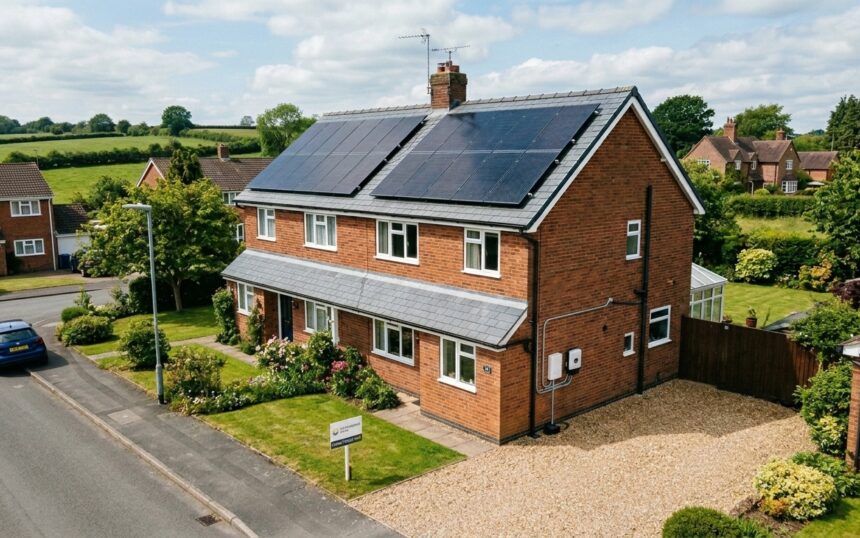
A typical 4kWp solar panel system in Staffordshire generates around 3,200–3,600 kWh of electricity per year. That’s enough to cover a significant portion of an average household’s annual electricity demand. Staffordshire receives slightly less sunshine than southern England — but more than enough to make solar a sound, long-term investment.
Does Staffordshire Get Enough Sun for Solar Panels?
Yes — comfortably.
Staffordshire sits in the West Midlands region and receives approximately 1,050–1,150 kWh of solar irradiance per square metre per year. That’s slightly below the UK average of 1,100–1,400 kWh/m², but well within the range where solar panels deliver strong returns.
For context:
- London averages around 1,200–1,300 kWh/m²
- Staffordshire averages around 1,050–1,150 kWh/m²
- Scotland averages around 900–1,050 kWh/m²
The difference between Staffordshire and London is modest — typically around 10–15% less annual output. That gap is easily offset by a correctly sized and well-positioned system.
Staffordshire towns including Stafford, Lichfield, Burton upon Trent, Tamworth, and Cannock all see very similar solar irradiance levels. There’s no significant variation across the county that would meaningfully affect your installation decision.
Does Rain Affect Solar Panels? →
How Much Electricity Can a Solar Panel System Generate in Staffordshire?
Output depends primarily on system size, roof orientation, and shading. Here are realistic annual generation estimates for common system sizes across Staffordshire:
| System Size | Estimated Annual Output (Staffordshire) | Typical Property Size |
| 2kWp | 1,600–1,800 kWh | Small flat or bungalow |
| 3kWp | 2,400–2,700 kWh | 2–3 bed semi-detached |
| 4kWp | 3,200–3,600 kWh | 3–4 bed detached |
| 5kWp | 4,000–4,500 kWh | Large detached or bungalow |
| 6kWp | 4,800–5,400 kWh | Large home or small commercial |
| 10kWp | 8,000–9,000 kWh | Commercial or large residential |
These figures assume a south-facing roof at a 30–35° pitch with no significant shading. East or west-facing roofs typically generate 15–20% less.
The average UK household uses approximately 3,500 kWh of electricity per year (Ofgem, 2024). A 4kWp system in Staffordshire can comfortably cover the majority of that demand.
What Factors Affect Solar Output in Staffordshire?
Several variables determine how much electricity your specific system will generate. Understanding these helps you set realistic expectations and make the right installation decisions.
- Roof Orientation: South-facing is optimal. A true south-facing roof at 30–35° tilt will generate the most electricity annually in Staffordshire. East or west-facing roofs are still viable — output drops by roughly 15–20%. North-facing roofs are generally not recommended for solar.
- Roof Pitch: The ideal pitch for the UK is between 30° and 40°. Shallower or steeper pitches reduce annual output. Flat roofs can use angled mounting frames to achieve the optimal tilt.
- Shading: This is one of the biggest variables. Trees, chimneys, neighbouring buildings, and aerials can all cast shadows across your panels at certain times of day. Even partial shading on one panel can reduce the output of the entire string — unless you have microinverters or power optimisers fitted.
- Panel Quality and Type: Modern monocrystalline panels are the standard choice for UK installations. They perform better in low-light and diffuse conditions than older polycrystalline technology. Premium panels from manufacturers such as SunPower, LG, or Jinko carry higher efficiency ratings and longer performance warranties.
- System Age: Solar panels degrade slightly over time — typically 0.3–0.5% per year. A well-maintained system should still produce around 85–90% of its original output after 25 years.
- Inverter Performance: Your inverter converts DC electricity from the panels into usable AC electricity. An undersized, ageing, or faulty inverter can reduce system output. Modern string inverters and hybrid inverters are highly efficient — typically 97–99%.
Month-by-Month Solar Output in Staffordshire
Here’s what a 4kWp south-facing system in Staffordshire can realistically generate each month:
| Month | Estimated Output (kWh) | Daylight Hours (avg) |
| January | 90–120 | 8.5 hrs |
| February | 130–170 | 10 hrs |
| March | 250–300 | 12 hrs |
| April | 350–400 | 14 hrs |
| May | 420–470 | 16 hrs |
| June | 440–490 | 16.5 hrs |
| July | 420–460 | 16 hrs |
| August | 380–420 | 14.5 hrs |
| September | 270–310 | 12.5 hrs |
| October | 170–210 | 10.5 hrs |
| November | 100–130 | 8.5 hrs |
| December | 70–100 | 8 hrs |
| Total | 3,090–3,580 kWh | — |
Spring and early summer are peak months in Staffordshire. May, June, and July consistently deliver the highest generation. Even in winter, panels generate useful amounts of electricity on bright, cold days.
How Does Staffordshire Compare to Other UK Regions?
| Region | Avg Solar Irradiance (kWh/m²/yr) | Est. Annual Output — 4kWp System |
| South West England | 1,250–1,400 | 3,750–4,200 kWh |
| South East England | 1,200–1,350 | 3,600–4,050 kWh |
| East Anglia | 1,150–1,300 | 3,450–3,900 kWh |
| Midlands (incl. Staffordshire) | 1,050–1,150 | 3,200–3,600 kWh |
| North West England | 1,000–1,100 | 3,000–3,300 kWh |
| Yorkshire | 1,000–1,100 | 3,000–3,300 kWh |
| Scotland | 900–1,050 | 2,700–3,150 kWh |
Staffordshire sits comfortably in the mid-range for UK solar output. The difference compared to the south coast is noticeable on paper — but in real-world terms, the financial returns remain strong.
How Much Money Can Solar Panels Save in Staffordshire?
Output figures only tell half the story. What matters to most homeowners is the financial return.
Based on a 4kWp system generating 3,400 kWh per year in Staffordshire:
- Energy bill savings: If you use electricity at home during the day, each kWh you generate avoids buying from the grid. At the current Ofgem price cap rate of approximately 24.5p per kWh (2024), self-consuming 50% of your generation saves:
1,700 kWh × £0.245 = approximately £416 per year
- Smart Export Guarantee (SEG) payments: Electricity exported to the grid earns you an export tariff. Leading SEG rates currently range from 4p to 15p per kWh depending on your supplier. Exporting the remaining 50%:
1,700 kWh × £0.06 (conservative rate) = approximately £102 per year
- Combined annual benefit: approximately £518 per year:
Add battery storage and self-consumption rises significantly — potentially pushing annual savings above £700–£900 for an average Staffordshire household.
Does Solar Affect My Home Insurance? →
What is the Payback Period for Solar Panels in Staffordshire?
A typical 4kWp solar installation in Staffordshire costs between £6,000 and £8,500 fully installed, including inverter and labour.
At £518 per year in combined savings and export income — without battery storage — the simple payback period is:
£7,000 ÷ £518 = approximately 13–14 years
Add a battery (typically £2,500–£4,000 extra) and higher self-consumption, and payback periods vary. However, solar panels carry 25-year performance warranties. Years 15–25 are essentially pure financial return — with zero fuel cost.
Energy prices are also expected to remain volatile. Every penny increase in the unit rate automatically improves your return.
Real-World Example: A Staffordshire Homeowner
Consider a four-bedroom detached property in Lichfield with a south-facing roof at 35°. The homeowners installed a 4.2kWp system with 10 monocrystalline panels and a 5kWh battery in spring 2023.
Results after 12 months:
- Total generation: 3,680 kWh
- Self-consumed: 2,210 kWh (60%)
- Exported to grid: 1,470 kWh
- Annual bill saving: approximately £541
- SEG income: approximately £88
- Total first-year benefit: £629
This is consistent with what Makse Electrical & Renewables observes across installations in Staffordshire. Results vary by household usage patterns, occupancy hours, and whether an electric vehicle or heat pump is also present.
How to Maximise Solar Output in Staffordshire?
- Shift energy use to daytime hours: Run dishwashers, washing machines, and tumble dryers during peak generation hours — typically 10am to 3pm on clear days. This maximises self-consumption and reduces your reliance on grid electricity.
- Add battery storage: A solar battery stores surplus daytime generation for use in the evening. This is one of the most effective ways to improve returns — particularly in Staffordshire where winter output is lower and evening demand is high.
- Consider a heat pump or EV charger: Pairing solar with an air source heat pump or electric vehicle charger dramatically increases the proportion of your total energy demand met by solar. Both can be timed to run during peak generation hours.
- Keep panels clean and well-maintained: Dirty panels underperform. A clean once or twice a year — particularly after dry spells — keeps your system generating at capacity.
- Monitor your system: Use your inverter’s monitoring app to track daily, monthly, and annual output. Catch faults early before they cost you generation.
Do Solar Panels Need Regular Cleaning? →
Is Solar Worth It in Staffordshire?
In short — yes.
Staffordshire may not have the sunshine hours of Cornwall or Sussex. But the financial case for solar in the Midlands remains strong, particularly with:
- Rising and volatile energy prices
- Strong SEG export tariffs available from major suppliers
- Falling installation costs over the past decade
- 0% VAT on residential solar installations (extended through 2027)
- 25-year panel performance warranties as standard
- Increased property value — Rightmove and Zoopla data consistently show solar adds value to UK homes
At Makse Electrical & Renewables, we’ve installed systems across Stafford, Lichfield, Tamworth, Cannock, Burton upon Trent, and the wider Staffordshire area. We understand local conditions, roof types, and the specific questions Staffordshire homeowners ask.
Key Takeaways
- A 4kWp system in Staffordshire generates around 3,200–3,600 kWh per year.
- Staffordshire receives 1,050–1,150 kWh/m² of solar irradiance annually — enough for a strong return.
- South-facing roofs at 30–35° deliver the best results.
- Annual savings of £400–£900+ are achievable depending on system size, usage, and battery storage.
- Typical payback period without battery is 13–14 years on a £7,000 system.
- Panels carry 25-year warranties — years 15–25 are near-pure financial return.
- Spring and summer are peak generation months; winter output is lower but not zero.
Frequently Asked Questions
- How much electricity do solar panels generate per day in Staffordshire?
A 4kWp system in Staffordshire generates an average of 8–10 kWh per day in summer and 2–4 kWh per day in winter. The annual daily average across all seasons is approximately 9 kWh per day.
- How many solar panels do I need for a typical Staffordshire home?
A 3–4 bedroom home typically requires a 4kWp system — around 10–12 standard 400W panels. The exact number depends on your roof space, orientation, and electricity consumption. Makse Electrical & Renewables provides a full site survey before recommending a system size.
- Do solar panels work in Staffordshire winters?
Yes. Output is significantly lower in winter — but panels still generate electricity on bright, cold days. December and January typically produce 70–120 kWh per month for a 4kWp system. Battery storage helps you make the most of every kWh generated.
- What direction should my roof face for solar in Staffordshire?
South-facing is ideal. East and west-facing roofs are viable and still deliver good returns. North-facing roofs are generally not suitable for solar panel installation in the UK.
- Will shading affect my solar output in Staffordshire?
Yes — shading is one of the most significant factors affecting output. Trees, chimneys, and neighbouring buildings can all reduce generation. A professional site survey identifies shading issues and recommends solutions such as microinverters or power optimisers.
- How long do solar panels last in Staffordshire?
Most modern solar panels carry a 25-year performance warranty and will continue generating electricity beyond that. Panel degradation is typically 0.3–0.5% per year. After 25 years, a quality panel will still produce around 85–90% of its original rated output.
- Is Staffordshire a good location for solar panels?
Yes. Staffordshire receives sufficient solar irradiance for a strong financial return. Thousands of homeowners across Stafford, Lichfield, Tamworth, Cannock, and Burton upon Trent already benefit from solar installations. The economics are compelling and improve further with battery storage.
- What is the best system size for a Staffordshire home?
For most 3–4 bedroom homes in Staffordshire, a 4kWp system is the most popular choice. Larger homes or those with an EV or heat pump may benefit from a 5–6kWp system. We always recommend a tailored assessment rather than a one-size-fits-all approach.
Ready to find out exactly how much your Staffordshire home could generate? Request a free solar survey from Makse Electrical & Renewables — we cover Stafford, Lichfield, Tamworth, Cannock, Burton upon Trent, and the surrounding area.