Solar Panel Maintenance: A Complete Guide for Staffordshire Homeowners
Solar panels are low-maintenance — but not zero-maintenance. A well-maintained system in Staffordshire lasts 25 years or more and performs close to its original rated output throughout. The essentials are simple: clean your panels once or twice a year, monitor your output regularly, and have a professional inspection every few years. Miss these steps and you risk reduced generation, undetected faults, and potentially voided warranties.
Why Does Solar Panel Maintenance Matter in Staffordshire?
Staffordshire’s climate brings a specific mix of maintenance challenges. The county sits in the West Midlands — an area with moderate rainfall, occasional heavy storms, significant agricultural dust in rural areas, and urban pollution in towns like Stafford, Tamworth, and Burton upon Trent.
Without regular upkeep, Staffordshire systems commonly suffer from:
- Soiling from road pollution and agricultural dust
- Bird fouling — particularly in rural and semi-rural properties
- Debris from nearby trees — especially in wooded areas around Cannock Chase
- Lichen and moss growth on older panels or frames
- Storm damage to mounting hardware during winter weather
The good news is that none of these is serious problems when caught early. A simple maintenance routine keeps your system generating at full capacity — and protects your investment for decades.
How Much Electricity Do Solar Panels Generate in Staffordshire? →
How Much Maintenance Do Solar Panels Actually Need?
Very little — compared to most home systems.
Solar panels have no moving parts. There’s nothing to oil, adjust, or replace on a regular basis. The maintenance burden is genuinely light for most homeowners.
Here’s a realistic overview:
| Task | Frequency | DIY or Professional? |
| Visual inspection from ground | Monthly | DIY |
| Check monitoring app for output dips | Weekly or monthly | DIY |
| Panel cleaning | 1–2 times per year | Professional |
| Full professional inspection | Every 3–5 years | Professional |
| Inverter health check | Every 3–5 years | Professional |
| Battery inspection (if fitted) | Annually | Professional |
| Mounting and frame check | Every 3–5 years | Professional |
| Wiring and connection inspection | Every 5 years | Professional |
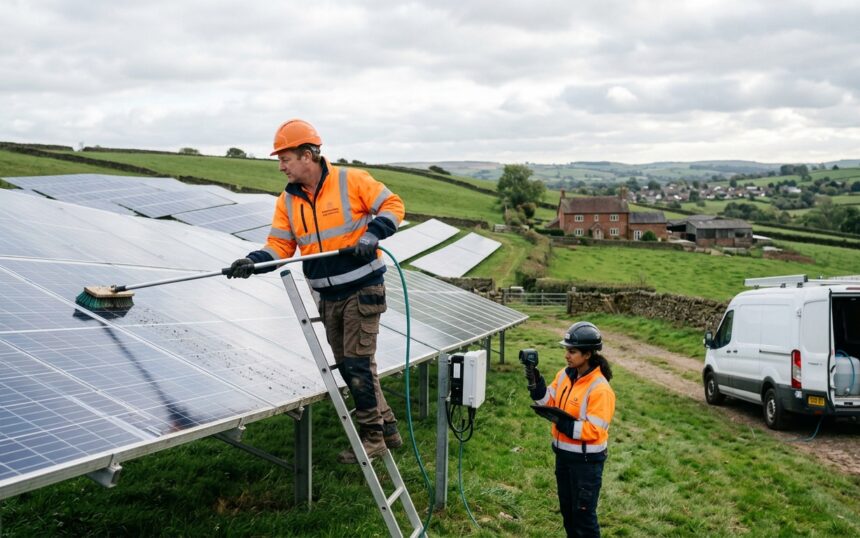
Most homeowners spend very little time on solar maintenance. The monitoring app check takes seconds. The annual clean takes an hour or less if done from ground level with a long-handled brush.
Solar Panel Cleaning: What Staffordshire Homeowners Need to Know?
Cleaning is the most frequent active maintenance task — and the one with the most direct impact on output.
How Often Should You Clean?
For most Staffordshire properties, once or twice a year is sufficient. We recommend:
- Spring (March–April): Clear winter grime before the peak generation season begins
- Late summer (August–September): Remove pollen, dust, and debris that builds up through summer
Properties near farmland — common across rural Staffordshire — may need cleaning more frequently due to agricultural dust and crop-spray residue. Similarly, properties under or near trees around Cannock Chase or the Staffordshire Moorlands should check panels more regularly for sap, pollen, and leaf debris.
Step-by-Step: How to Clean Your Solar Panels Safely
Before you start: Turn off your solar PV system following your inverter’s shutdown procedure. Never clean panels while the system is live.
Step 1 — Choose the right time Clean in the early morning or evening. Midday sun heats panels significantly. Cold water on hot glass risks thermal stress and surface cracking.
Step 2 — Use the right equipment A soft-bristle brush on a long handle, a gentle hose, and lukewarm water is all you need for most cleans. Deionised water gives the best finish — especially in Staffordshire’s hard water areas around Lichfield and Tamworth, where tap water leaves mineral streaks.
Step 3 — Work from the ground where possible Many single-storey and low-pitch installations can be cleaned safely from the ground with an extendable brush. If your roof requires ladder access, consider a professional clean — working at height carries serious risk.
Step 4 — Apply water, then brush gently Wet the panels first. Use gentle, circular strokes with the soft brush. Do not scrub — solar panel glass is durable but not indestructible.
Step 5 — Rinse thoroughly Soap or cleaning product residue attracts more dirt. Rinse until the water runs clear.
Step 6 — Allow to air dry Or use a soft squeegee to remove excess water without scratching.
What to Avoid
- Pressure washers — too forceful, can damage seals and wiring
- Abrasive cloths or sponges — scratch the glass surface
- Strong chemical cleaners — leave residue and can degrade panel coatings
- Cleaning in direct midday sun — thermal shock risk
- Walking on panels — never, under any circumstances
Monitoring Your Solar System: The Easiest Maintenance Task
Modern solar inverters come with monitoring apps — and checking yours regularly is the single most effective maintenance habit you can build.
Most systems allow you to track:
- Daily, monthly, and annual generation figures
- Real-time output in kilowatts
- Export to grid and import from grid (on smart meters)
- Fault alerts and error codes
- Individual panel performance (on systems with microinverters or optimisers)
What to look for:
A sudden, unexplained drop in output is the clearest signal that something needs attention. Common causes include:
- Dirty or shaded panels
- Inverter fault or error code
- Grid connection issue
- Damaged panel or wiring problem
- Battery fault (if storage is fitted)
Check your app at least once a month. Compare output to the same period last year if data is available. Seasonal variation is normal — an unexplained dip outside of that pattern warrants investigation.
Solar Energy UK — Monitoring Your Solar System
Professional Solar Panel Inspections: What’s Involved?
A DIY clean and monthly monitoring check covers the basics. But every 3–5 years, a professional inspection adds a layer of assurance that protects your system and your warranty.
At Makse Electrical & Renewables, our Staffordshire maintenance visits include:
1. Visual panel inspection:
We check every panel for microcracks, delamination, discolouration, and surface damage. Microcracks are invisible to the naked eye from the ground — a close-up inspection catches them before they develop into significant faults.
2. Thermal imaging (infrared scan):
Thermal imaging identifies hotspots — areas of abnormal heat caused by cell degradation, soiling, or internal faults. A hotspot left unaddressed accelerates panel degradation and, in rare cases, can be a fire risk.
3. Inverter inspection and diagnostics:
We run diagnostics on your inverter, check error logs, assess efficiency, and identify any signs of early failure. Inverters typically last 10–15 years — earlier than the panels themselves. Catching decline early avoids unexpected outages during peak generation months.
4. Mounting and frame inspection:
We check all fixings, rails, and roof penetrations for corrosion, loosening, or movement. Staffordshire’s winter storms occasionally shift poorly secured mounting hardware. Catching this early prevents roof damage and panel movement.
5. Wiring and connection check:
DC wiring on rooftops is exposed to UV, heat cycling, and weather year after year. We check for degraded insulation, loose connections, and signs of water ingress at junction boxes.
6. Battery inspection (if fitted):
Battery storage systems require their own annual health check — state of health readings, connection checks, and firmware updates where applicable.
7. Full written report:
We provide a written report covering findings, any recommended actions, and a system performance assessment. This is useful for your records, your insurer, and any future property sale.
Common Solar Panel Problems in Staffordshire — and How to Fix Them
1. Soiling and Bird Fouling
The most common issue across Staffordshire — particularly in rural areas and properties near the Staffordshire Moorlands, Cannock Chase, or agricultural land. Bird droppings are acidic and reduce output significantly when concentrated on cells.
Fix: Regular cleaning. For persistent bird fouling, consider anti-roosting spikes or pigeon-proofing mesh fitted around the panel perimeter. Makse Electrical & Renewables installs pigeon-proofing as part of our maintenance service.
2. Inverter Faults
Inverters are the component most likely to require attention during a system’s lifetime. Common fault codes include grid disconnection errors, isolation faults, and over-temperature warnings.
Fix: Check your monitoring app for the specific error code. Many minor faults self-resolve — the inverter resets overnight. Persistent or recurring errors require a professional diagnostic visit. Don’t ignore fault codes — they indicate your system is not generating at full capacity.
3. Shading from Tree Growth
Trees grow. A tree that posed no shading issue at installation can cast shadows on your panels five years later — particularly during winter months when the sun is lower in the sky.
Fix: Monitor seasonal output carefully. If winter output has declined year-on-year, new shading may be the cause. Tree trimming is often the simplest solution. In some cases, adding microinverters or power optimisers can mitigate shading impact without removing vegetation.
4. Microcracks
Microcracks in photovoltaic cells are invisible from the ground but can reduce output significantly. They’re caused by physical stress during installation, thermal cycling, or hail impacts.
Fix: Thermal imaging during a professional inspection identifies microcracks. Affected panels may need replacement depending on severity. This is covered under manufacturer warranty in many cases — another reason to keep your installation documentation.
5. Lichen and Moss
Less common on panels themselves but occasionally found on frames and mounting rails — particularly on older systems in shadier or more rural parts of Staffordshire.
Fix: A professional clean with appropriate treatment. Do not use bleach or harsh chemicals on or near panels.
6. Loose Mounting Hardware
Staffordshire experiences significant wind events — particularly in exposed locations on higher ground in the Staffordshire Moorlands. Mounting fixings can loosen over time.
Fix: A professional inspection checks all fixings torque values and roof penetration integrity. Never attempt to tighten roof fixings yourself without the correct equipment and training.
Solar Panel Maintenance Checklist for Staffordshire Homeowners
Use this checklist to stay on top of your system’s health throughout the year.
Monthly (DIY)
- Check monitoring app — review output vs previous month and same month last year
- Note any fault alerts or error codes
- Visual ground-level check for visible debris or damage
Spring (DIY or Professional)
- Full panel clean before peak season
- Check for bird fouling or nesting activity around panel edges
- Check for any winter storm damage — loose panels, damaged frames
- Review annual output from previous year vs expected figures
Autumn (DIY or Professional)
- Second clean of the year — clear summer pollen and debris
- Check monitoring app data for any unexplained output dips over summer
- Clear any leaf debris from panel surfaces and gutters near panels
Every 3–5 Years (Professional)
- Full professional inspection including thermal imaging
- Inverter diagnostics and health check
- Mounting and wiring inspection
- Battery health check (if applicable)
- Written inspection report for your records
Does Solar Panel Maintenance Affect My Warranty?
Yes — neglect can affect your warranty, so it’s worth understanding what your warranties cover.
Most solar installations come with three separate warranties:
- Panel performance warranty: Typically 25 years. Guarantees that panels will produce at least 80–85% of their rated output after 25 years. Generally not affected by normal soiling but can be impacted by physical damage caused by incorrect cleaning methods.
- Panel product warranty: Typically 10–15 years. Covers manufacturing defects. Using unauthorised cleaning chemicals or abrasive tools can void this warranty — always follow manufacturer guidelines.
- Inverter warranty: Typically 5–12 years depending on manufacturer. Extended warranties are available for purchase. Faults caused by incorrect installation or tampering void the warranty — always use a qualified engineer for inverter work.
- Workmanship warranty: Provided by your installer. At Makse Electrical & Renewables, we provide a workmanship warranty on all installations. This covers any faults arising from the installation itself — roof penetrations, wiring, mounting, and commissioning.
Keep all your warranty documents, installation certificates, and MCS documentation in a safe place. You’ll need them if a warranty claim arises — and when you come to sell your property.
How Much Does Solar Panel Maintenance Cost in Staffordshire?
Solar maintenance is genuinely affordable — particularly relative to the value of the system and the savings it generates.
| Service | Estimated Cost (Staffordshire) |
| Professional panel clean (domestic) | £60–£120 |
| Professional inspection (visual) | £100–£200 |
| Full inspection with thermal imaging | £150–£300 |
| Inverter replacement (supply and fit) | £500–£1,200 |
| Single panel replacement | £200–£400 |
| Pigeon proofing (full installation) | £200–£500 |
| Battery health check | £75–£150 |
| Annual maintenance plan | £150–£250 per year |
An annual maintenance plan from a local provider like Makse Electrical & Renewables typically includes a professional clean, visual inspection, monitoring review, and written report — all for a predictable annual fee.
External link: MCS — Find a Certified Solar Installer
Should You Take Out a Solar Panel Maintenance Plan?
For most Staffordshire homeowners, a maintenance plan offers good value and peace of mind.
Benefits of a maintenance plan:
- Regular professional attention without having to remember to book
- Priority response if a fault develops
- Consistent written records for warranty and insurance purposes
- Often cheaper than ad-hoc call-outs
- Ensures your system is inspected by qualified engineers annually
Who benefits most:
- Homeowners with battery storage (more components to maintain)
- Older systems (5 years or more)
- Rural properties with high bird fouling or dust exposure
- Homeowners who prefer not to clean panels themselves
- Properties with complex or large rooftop installations
At Makse Electrical & Renewables, our Staffordshire maintenance plans are tailored to your system size and age. Contact us for a quote.
Key Takeaways
- Solar panels are low-maintenance but benefit significantly from a simple annual routine.
- Clean panels once or twice a year — spring and late summer are ideal in Staffordshire.
- Check your monitoring app monthly to catch output dips and fault alerts early.
- A professional inspection every 3–5 years protects warranties and catches hidden faults.
- Common Staffordshire issues include bird fouling, agricultural dust, tree shading, and winter storm damage.
- Inverters typically need replacing after 10–15 years — budget for this in your long-term planning.
- Keep all warranties, MCS certificates, and inspection reports in a safe place.
- A maintenance plan offers the best value for ongoing professional care.
Frequently Asked Questions
- How often do solar panels need servicing in the UK?
Most UK homeowners should schedule a professional inspection every 3–5 years. Annual cleaning and monthly monitoring checks can be done by the homeowner. Battery storage systems benefit from an annual professional health check.
- Do solar panels need maintenance in winter?
Minimal active maintenance is needed in winter. Keep panels clear of heavy snow accumulation if safe to do so from the ground — snow blocks light. Check your monitoring app after any significant storm. Schedule your spring clean as soon as temperatures rise.
- How do I know if my solar panels are working properly?
Your monitoring app is the best indicator. Check that daily output is consistent with expected seasonal figures. A sudden unexplained drop — not explained by weather — warrants investigation. Compare month-on-month and year-on-year figures for a clear picture.
- Can I clean my solar panels with washing-up liquid?
A small amount of mild washing-up liquid in lukewarm water is generally acceptable for a light clean. Use sparingly and rinse thoroughly — residue attracts dirt. For a streak-free finish, deionised water is preferable, particularly in Staffordshire’s hard water areas.
- What happens if I don’t maintain my solar panels?
Neglected panels accumulate dirt, which reduces output. Undetected faults go unrepaired, potentially causing further damage. Warranties may be voided if damage results from negligence. Over time, an unmaintained system generates significantly less electricity than a well-maintained one — directly affecting your financial return.
- How long do solar panels last in Staffordshire?
Quality solar panels carry 25-year performance warranties and routinely operate beyond that. With proper maintenance, a Staffordshire system installed today should still be generating useful electricity in 2050 and beyond.
- Do I need a professional to clean my solar panels?
Not necessarily. Ground-level or easily accessible panels can be safely cleaned by the homeowner with the right equipment. Roof-mounted systems requiring ladder access are better handled by a professional — working at height is hazardous without proper training and equipment.
- What is thermal imaging for solar panels?
Thermal imaging uses an infrared camera to detect hotspots — areas of abnormal heat caused by cell damage, soiling, or internal faults. It’s one of the most effective diagnostic tools available for solar panels and is included in professional inspection services from Makse Electrical & Renewables.
Will a dirty solar panel damage itself? Prolonged heavy soiling — particularly concentrated bird droppings — can cause hotspots that accelerate cell degradation. In extreme cases, this can permanently reduce panel output. Regular cleaning prevents this.
- Is it worth getting a maintenance plan for solar panels in Staffordshire?
For most homeowners — particularly those with battery storage or systems over five years old — yes. A maintenance plan provides regular professional attention, priority fault response, and consistent documentation for a predictable annual cost.
Want a maintenance visit or a free system health check? Contact the Makse Electrical & Renewables team — we serve Gnosall, Newport, Rugeley, Shifnal, Codsall and the wider Staffordshire area.